
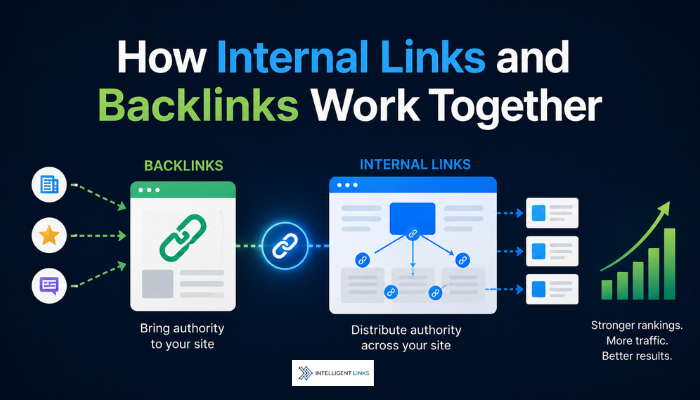
Backlinks build your website’s authority, and internal links distribute it. Together, they form the two-sided system that moves your pages up in Google search results. But most businesses focus on earning backlinks and never set up the internal link structure to distribute that authority.
You’ve probably earned a backlink or two, watched your domain rating tick up, and then waited for rankings that never came. Because when a backlink lands on a page with no internal linking SEO structure behind it, the authority has nowhere to go. It stays on that one URL and does nothing for the rest of your site.
At www.intelligentlinks.com.au, we’ve worked with Australian businesses across dozens of industries on this problem. A strong backlink profile sitting on top of a weak internal link structure consistently underperforms, and we come across this combination all the time.
This article explains how both link types work together and in what order to build them. Read on to find out how to stop wasting the authority you’ve already earned.
What Internal Links and Backlinks Do
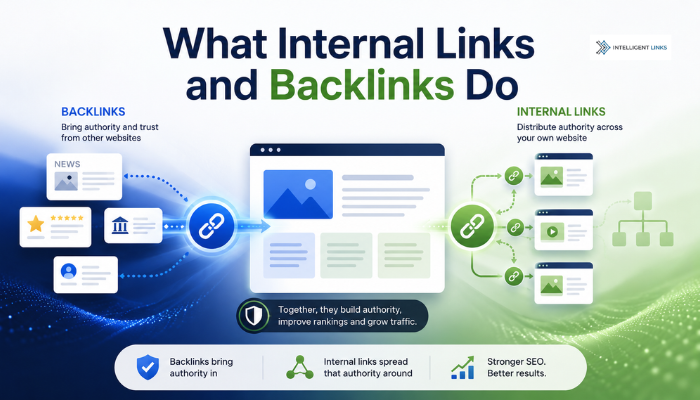
Internal links and backlinks both pass SEO authority and help search engines navigate your site, but with a fundamental difference. Backlinks generate brand-new trust from the internet at large, while internal links distribute that trust across your own website.
Internal links connect one page on your site to another. As Google Search Central confirms, every page you care about should have at least one internal link pointing to it. Without that, Google’s crawlers can struggle to find it and pull it into the search engine’s database.
On the other hand, backlinks come from other websites pointing to yours. Google treats them as votes of confidence, and the more credible those sites are, the more authority they pass on.
Plus, high-quality backlinks from relevant websites carry more weight. Google treats topical relevance as a signal of genuine endorsement, and that directly influences how much authority gets passed to your page.
Why You Need Both
You need both because they solve two different problems. Backlinks bring authority in, while internal links move it around. Run only one, and you’ll hit a ceiling more quickly.
A site with strong backlinks but poor internal linking holds authority on a handful of pages while the rest of the site goes unnoticed in search results. On the flip side, a well-linked site with no backlinks simply doesn’t have enough authority to compete.
Search engine optimisation rewards sites that do both well. Internal links tell Google how your site is structured, and backlinks tell Google your site is worth ranking. Together, they cover what they create a combination that drives consistent organic traffic over time.
How Internal Linking SEO Turns One Backlink Into Sitewide Authority
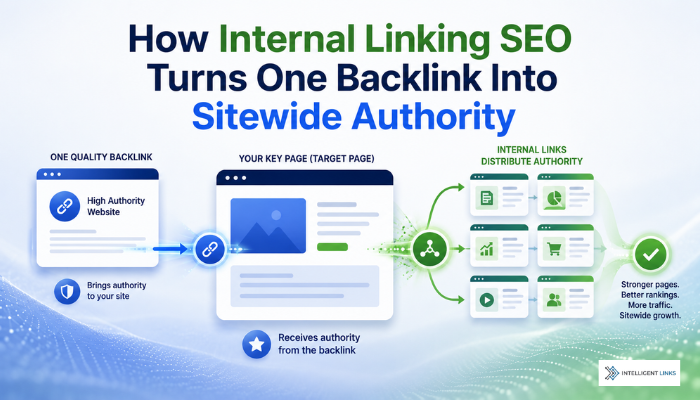
One well-placed backlink can lift multiple pages in Google search results, but only when your site gives that authority somewhere to go. Read on, and it will start to make a lot of sense.
Context Decides How Much Link Equity Passes Through
Not every internal link carries the same value. A link placed inside the body copy of a relevant article passes far more link equity than one sitting in a footer. The reason is that Google reads the content around a link to work out what the linked page is about. Relevant context around that link directly determines how much value flows through.
Ahrefs notes that link equity is a confirmed ranking factor. So, where you place your internal links genuinely changes how much authority each page receives.
Your Best Pages Are Your Strongest Distribution Tools
Think about the pages on your site already getting organic traffic. Those pages hold the most authority. When you add internal links from them to newer or lower-ranked pages, you push equity toward pages that need it.
For example, a blog post ranking on page one of Google search results can help lift your service page simply by linking to it. Most site owners overlook this completely (and it costs nothing to fix).
Orphan Pages Receive Zero Authority
If your site has pages with no internal links pointing to them, those pages are invisible to search engines. So they receive no link equity from your domain. Broken links make this worse.
The fix is to connect orphan pages to relevant, high-authority pages through contextual links. Once connected, they start receiving equity that they were never getting before.
At Intelligent Links, we audit internal link structures as part of every engagement. And the results speak for themselves.
What to Do First: Building Backlinks or Setting Up Internal Links?
Set up your internal link structure first. When a backlink lands on a well-connected page, the authority travels. When it lands on an isolated page, it stops right there.
You might be wondering why the order is so important. Think of it this way: every time you earn a backlink, Google’s search algorithm follows that link to your page and starts reading your site structure from there.
If your internal links are already in place, Google crawls from that page to your other pages and distributes authority across them. If they’re not, that backlink does one page’s worth of work instead of your whole site’s.
Below, we cover the two steps that make this work: building your content cluster and following a simple starting sequence.
Build Your Content Cluster First
A content cluster is a group of pages built around one central topic. You have one main page targeting your primary keyword, supported by a group of blog posts and pages covering related subtopics.
All of those supporting pages link back to the central page, and the central page links out to them. That two-way connection is what builds topical authority in Google’s search engine, and it’s what separates sites that rank consistently from those that don’t.
When a backlink hits any page in the cluster, the authority spreads across the whole group rather than staying on one URL. In fact, a backlink landing on an isolated page does one page’s worth of work.
As Ahrefs found, links remain one of Google’s strongest ranking signals, and a connected site structure is what lets those signals travel. Our content cluster strategy service maps and builds this architecture so your backlinks work harder from day one.
A Simple Three-Step Starting Sequence
Getting both strategies working together doesn’t require a big budget or an SEO tool. Start with these three steps and build from there:
- Identify Your Target Page: Start with the one page you most want to rank in Google search results. This becomes the centre of your content cluster.
- Build Your Supporting Pages: Create or connect 3 to 5 supporting pages that link back to your target page using relevant keywords and descriptive anchor text.
- Pursue Valuable Backlinks: Go after backlinks to both the central page and its supporting content. Every link you earn now works across the whole cluster.
Say you run a Brisbane accounting firm and your target page is your tax advisory service. Without internal links pointing to it, a backlink from an industry publication lands there and goes no further. Add three supporting blog posts covering related search queries, all linking back to that service page. Now that the same backlink lifts the authority of four pages at once.
Search rankings improve across the board, search competitors become easier to close the gap on, and your organic SEO growth compounds with every new link you earn.
On top of that, generative engine optimisation and AI-generated answers in traditional search results are starting to favour sites with strong topical authority.
A content cluster builds exactly that, by signalling to search engines like Google that your site covers a topic in depth. That’s becoming a bigger part of how sites get surfaced in both standard and AI-powered search results.
Where to Go From Here
Internal links and backlinks serve different roles, and that difference is worth understanding. Get your internal link structure in place first, then go after backlinks. Do it in that order, and your SEO strategy starts compounding with every link you earn.
A site with strong backlinks but no internal structure wastes most of the authority it brings in. On the other hand, solid internal linking with no external links never builds enough website authority to compete. You need both sides working together.
And if you’d rather skip the guesswork, Intelligent Links can help. Our editorial placements and content cluster strategy work together to earn authority and distribute it across your site.
Get in touch today, and let’s build both sides of your link strategy properly.